Learning Shouldn’t Always Feel Easy
Imagine two students preparing for an examination.
The first student reads the same chapter four times. By the end, the content feels familiar, almost effortless. Confident, the student closes the book believing the topic has been mastered.
The second student reads the chapter once, closes the book, and attempts to explain the concepts from memory. The effort is frustrating. Several ideas are forgotten. Mistakes are made. The student returns to the text, fills the gaps, and repeats the process over several days.
If both students take the examination a month later, cognitive science suggests that the second student is far more likely to remember and apply what was learned.
This seems counterintuitive. We often assume that learning should become easier with repetition. In reality, some of the most effective learning experiences are deliberately challenging.
Researchers call these challenges desirable difficulties—learning conditions that require greater mental effort in the short term but produce stronger understanding and longer-lasting memory in the long term.
The implication is profound. If we want better learning, we should not always aim to make learning easier. We should aim to make it more meaningful.
The Difference Between Performance and Learning
One of the biggest misconceptions in education is confusing performance with learning.
A student who answers every question correctly immediately after a lesson appears to have learned the material. But this immediate success often reflects short-term performance rather than durable learning.
Real learning is revealed much later:
- Can the learner remember the concept after several weeks?
- Can it be applied in a completely new situation?
- Can it be explained in simple language?
- Can it be connected with previously learned ideas?
These questions measure understanding rather than temporary recall.
Unfortunately, many classrooms optimise for immediate performance because it is easier to observe. Deep learning, however, often looks slower and less polished in the beginning.
What Are Desirable Difficulties?
The term desirable difficulties was introduced by cognitive psychologist Robert A. Bjork to describe learning experiences that feel effortful but ultimately improve retention and transfer.
The keyword is desirable.
Not every difficulty helps learning.
An unreadable textbook, poor teaching, or confusing instructions create unnecessary obstacles. Those are undesirable difficulties.
Desirable difficulties are carefully designed challenges that require learners to retrieve, organise, connect, and apply knowledge.
They increase mental effort without increasing confusion.
Just as muscles become stronger through appropriate resistance, memory becomes stronger through appropriate cognitive effort.
Why Easy Learning Can Be Misleading
Our brains are surprisingly poor judges of what we have actually learned.
When we reread notes repeatedly, everything begins to feel familiar. This familiarity creates an illusion of mastery.
Psychologists refer to this as a fluency illusion.
Information that is easy to process often feels as though it has been learned, even when it has not.
Many students discover this only during examinations, when they realise they recognised the material but could not recall or apply it independently.
Effective learning is not measured by how familiar information feels while studying.
It is measured by what remains after the book has been closed.
Six Evidence-Based Learning Strategies
1. Retrieval Practice
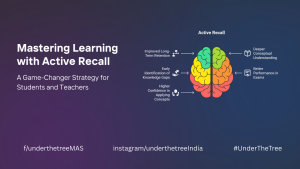
Instead of repeatedly reading information, learners should regularly retrieve it from memory.
Closing the book and attempting to explain a concept forces the brain to reconstruct knowledge.
Every successful retrieval strengthens future recall.
Simple classroom examples include:
- Low-stakes quizzes
- Self-testing
- Explaining concepts without notes
- Teaching a peer
Testing, in this context, is not merely an assessment tool.
It is a learning strategy.
2. Spaced Learning
Learning improves when study sessions are distributed over time rather than concentrated into a single marathon session.
Spacing allows partial forgetting to occur.
When learners later retrieve the information, the effort required strengthens memory.
This is one reason why studying for twenty minutes across five days is often more effective than studying for one hundred minutes on a single evening.
3. Interleaving
Traditional teaching usually groups similar problems together.
Students solve twenty algebra problems followed by twenty geometry problems.
Interleaving mixes different concepts within the same session.
Because learners must decide which method applies to each problem, they develop stronger judgement instead of relying on repetitive patterns.
The practice feels harder.
The learning becomes deeper.
4. Generation Before Instruction
Instead of immediately showing the correct answer, teachers can first encourage learners to predict, estimate, or attempt a solution.
Even unsuccessful attempts prepare the brain to understand subsequent explanations.
Struggle, when guided appropriately, becomes productive rather than discouraging.
5. Elaborative Questioning
Learning deepens when students continually ask:
- Why is this true?
- How does this relate to something I already know?
- Where could I apply this idea?
- What would happen if the conditions changed?
These questions transform isolated facts into connected knowledge.
6. Reflection
Learning is incomplete without reflection.
Students should periodically consider:
- What did I understand?
- What still confuses me?
- What mistakes did I make?
- What strategy helped me most?
Reflection develops metacognition—the ability to think about one’s own thinking—which is one of the strongest predictors of independent learning.
What This Means for Teachers
Teachers often feel pressure to ensure that every lesson appears smooth and effortless.
Learning science suggests a different goal.
Rather than removing every challenge, teachers should design meaningful challenges.
This could include:
- Asking students to explain instead of repeat.
- Encouraging multiple solution paths.
- Revisiting topics after several weeks.
- Using frequent low-stakes quizzes.
- Allowing productive struggle before offering complete solutions.
The classroom becomes a place where thinking is visible.
What This Means for Parents
Parents naturally want to help.
Sometimes, however, helping too much reduces learning.
Providing every answer immediately deprives children of the opportunity to think independently.
Instead, parents can ask questions like:
- “How would you solve it?”
- “Can you explain your reasoning?”
- “What makes you think that?”
The objective shifts from completing homework to developing thinking.
What This Means for AI-Powered Learning
Artificial intelligence offers an exciting opportunity to bring desirable difficulties into everyday learning.
Instead of simply providing answers, intelligent learning systems can:
- Ask learners to retrieve previous knowledge.
- Adjust challenge according to individual progress.
- Schedule revision using spaced repetition.
- Encourage reflection after every learning session.
- Generate problems that require transfer rather than memorisation.
The most valuable educational AI will not be the one that makes learning effortless.
It will be the one that knows when to challenge and when to support.
A New Way to Think About Education
For decades, educational success has often been measured by how efficiently teachers deliver information.
The future demands a different question:
How effectively are learners constructing understanding?
This shift moves education away from content delivery and toward capability development.
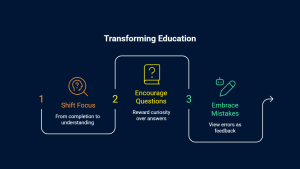
It encourages curiosity over compliance, understanding over memorisation, and long-term growth over short-term performance.
Learning that feels easy is not always learning that lasts.
The evidence from cognitive science is remarkably consistent: appropriately designed challenges help learners remember more, understand more deeply, and apply knowledge more effectively.
The goal of education should therefore not be to eliminate difficulty.
It should be to design the right kind of difficulty.
At Jyoti EdLab, we believe that the future of education lies at the intersection of learning science, thoughtful teaching, and responsible innovation. By translating research into practical strategies, we hope to help educators, parents, policymakers, and learners build educational experiences that are not merely easier—but genuinely more effective.
Because the purpose of education is not simply to help students succeed in the next examination.
It is to help them continue learning for the rest of their lives.